Reviewed by Makai Kellogg
Review Source: Teaching for Change
Book Author: Lana Button, Eric Walters
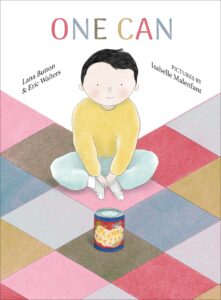
One Can, by Lana Button and Eric Walters, tells the story of a child who experiences both giving and receiving. There is a schoolwide food and mitten drive and the child is excited to contribute toward the classroom goal of 100 cans “for people in need.” After the can the child donated makes it back home, they realize that their family is a beneficiary of food assistance.
This part of the story humanizes the often invisible “those in need” to both the reader and the main character. Instead of centering a savior narrative, the act of giving is explained as sharing extra items with people who need them. The child thinks a lot about other people in need and chooses to share something the child loves that another child could use.
The book was free of the typical negative stereotypes or beliefs related to poverty or food insecurity. For example, a positive conversation was included that didn’t place value on either the child who ate a school lunch or one with a homemade lunch.
The authors address how financial hardship can be temporary. The mother explains, “We are getting some help, for now.” The recent federal government shutdown led many families to experience significant but not permanent financial strain, while there are systemic factors that consistently keep families in cycles of poverty.
Reflecting on the story, illustrations, and messages, I wondered how the children in the school were prepared for participating in both the food and mitten drive, what I would do as an early childhood educator, and how to use One Can to meet anti-bias goals.
Chapter 10 in the indispensable text, Anti-Bias Education for Young Children and Ourselves, provides insight with real examples, debunks myths, offers strategies to foster non-classist assumptions and interactions, as well as ways to support families across economic class.
From page 137 of this text, there are two “Anti-Bias Education Goals to Learning About Economic Class” that I observe in One Can:
Goal 1 — Children will feel pride in their family’s efforts to care for them and earn a living. They will feel love and approval separate from gifts and objects.
Goal 4 — Children will learn ways to help others without feeling superior to them and to stand up for themselves and others against teasing or rejection based on economic class.
And from page 143, two tips that can be connected to this picture book — or any school’s donation project — include:
Focus on justice rather than charity.
Be cautious of introducing activities to “help poor people,” which can unintentionally convey messages of the superiority of the helper and the helplessness of the receiver.
One Can explores empathy and food insecurity in child-friendly language that can be used to support conversations at home or in the classroom on wants versus needs, community service projects, and economic justice.
Makai Kellogg is an anti-bias early childhood educator and Equity and Diversity Coordinator at School for Friends in Washington, D.C. She creates age-appropriate curriculum on social justice for her students to explore equity issues such as race, homelessness, gender stereotypes, etc. Makai leads the Parents of Multiracial Children group, Equity and Diversity Parent Book Club, as well as other programming throughout the year that allow parents to address their biases to be proactive as their children learn about the world around them. Makai facilitates training and opportunities for her colleagues to engage in identity work and discussions on equity and anti-bias education in the classroom. Through her work with young children and their families, she is creating an inclusive community of critical thinkers and change makers. Makai works closely with Teaching for Change and its initiative, the D.C. Area Educators for Social Justice as an advisory board member. She is also part of the leadership team for the Anti-Bias Early Childhood Educator Working Group. Read more on Makai’s Early Childhood Equity Endeavors.
Find more books on this topic on our Learning about Economic Class booklist.

One Can by Lana Button, Eric Walters
Published by Groundwood Books Ltd on September 2, 2025
Genres: Economic Class
Pages: 34
Reading Level: Early Childhood, Grade K
ISBN: 9781773067353
Review Source: Teaching for Change
Also by this author: Hope Springs, Walking Home
A child donates a can of food to their school food drive. But in an unexpected twist, they come to understand what it means to give and receive.
A child is excited to donate a can of their favorite Zoodelicious to the school food drive. Their teacher has explained that the food will be given to people in need, along with mittens from the “mitten tree.”
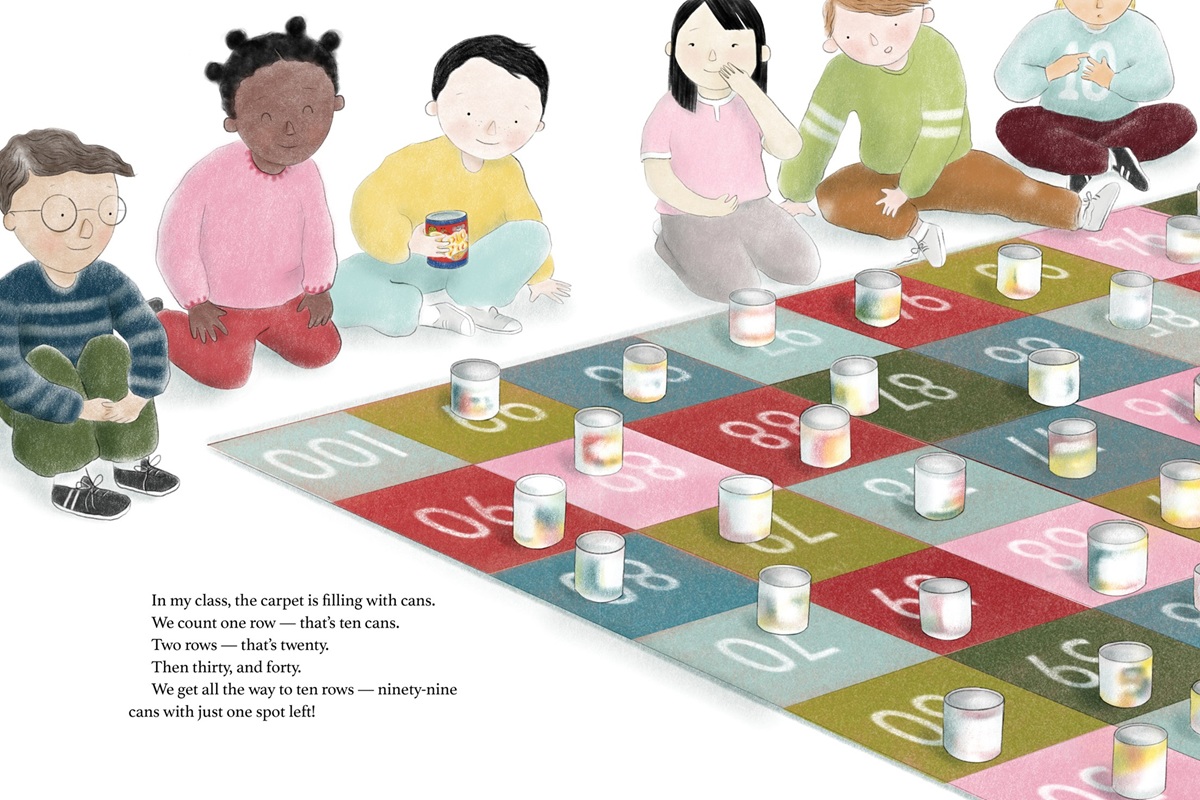
In the classroom, there’s a carpet with one hundred squares, and the goal is to fill each square with a can of food. When the child places their can of Zoodelicious on square 100, everyone cheers, and the teacher puts a snowflake sticker on top to celebrate.
But a few days later, the child finds the same can of Zoodelicious among the groceries their mom has brought home. There’s a pair of red mitts, too. “Mom, are we the people in need?” the child asks.
The next morning, after having thought of all the people who will receive food from the school and wondering what else they might need, the child donates their too-small blue mittens to the mitten tree at school.
Created by an award-winning team, One Can tells a timely and touching story of a child who learns to give and receive — and wants only to give again in return.
Key Text Features
dialogue
illustrations
Correlates to the Common Core State Standards in English Language Arts:
CCSS.ELA-LITERACY.RL.1.3
Describe characters, settings, and major events in a story, using key details.
One Can by Lana Button, Eric Walters
Published by Groundwood Books Ltd on September 2, 2025
Genres: Economic Class
Pages: 34
Reading Level: Early Childhood, Grade K
ISBN: 9781773067353
Review Source: Teaching for Change
Also by this author: Hope Springs, Walking Home
A child donates a can of food to their school food drive. But in an unexpected twist, they come to understand what it means to give and receive.
A child is excited to donate a can of their favorite Zoodelicious to the school food drive. Their teacher has explained that the food will be given to people in need, along with mittens from the “mitten tree.”
In the classroom, there’s a carpet with one hundred squares, and the goal is to fill each square with a can of food. When the child places their can of Zoodelicious on square 100, everyone cheers, and the teacher puts a snowflake sticker on top to celebrate.
But a few days later, the child finds the same can of Zoodelicious among the groceries their mom has brought home. There’s a pair of red mitts, too. “Mom, are we the people in need?” the child asks.
The next morning, after having thought of all the people who will receive food from the school and wondering what else they might need, the child donates their too-small blue mittens to the mitten tree at school.
Created by an award-winning team, One Can tells a timely and touching story of a child who learns to give and receive — and wants only to give again in return.
Key Text Features
dialogue
illustrations
Correlates to the Common Core State Standards in English Language Arts:
CCSS.ELA-LITERACY.RL.1.3
Describe characters, settings, and major events in a story, using key details.
Leave a Reply