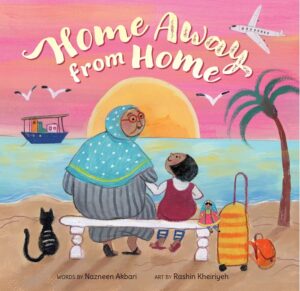
Reviewed by Paige Pagan
Review Source: Teaching for Change
Book Author: Nazneen Akbari
Home Away From Home is a picture book for young elementary readers that dissects the concept of home as both a physical and mental refuge and encourages children to be open to exploring the unfamiliar, which contributes to building a more faceted sense of selfhood.
Nuha isn’t excited to visit her Jadda in Oman because it’s so far from her home and she barely remembers her grandmother. Nuha’s only semblance of familiarity is her doll, Mary, but when she accidentally leaves Mary in the car on the way to the airport, Nuha is distraught. In Oman, Jadda attempts to connect with Nuha by taking her to the souk to find an Omani doll.
At first, Nuha is weary of all the ways Omani culture is different from what she knows — from the dancing and music to the women in abaya and hijab and from the brown dolls to the steaming street shawarma. But with Jadda’s gentle guidance and patience, Nuha begins to see Oman through fresh, unbiased eyes and comes to believe that her mother was correct in her assessment that Oman is their home away from home. In a symbolic ending where both Western and Middle Eastern culture and Christianity and Islam are bridged, Nuha finds a doll whom she names Maryam, the Arabic translation of Mary, and balance is restored.
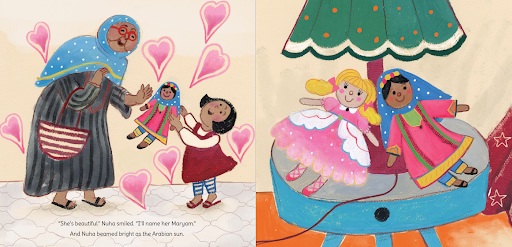
While I was equally excited for an Omani text that covered important topics like home, belonging, and identity in an accessible way for young readers as the Islamic School Librarian expresses in their book review of this title, I thought the symbolism felt heavy-handed, literal, and stereotypical. Akbari’s choice of presenting a doll that is white, golden haired, and in a princess dress as a cultural symbol of Western identity, especially as opposed to Nuha’s brown Omani doll with a veil and salwar-esque outfit, feels as dated as the 1972 picture book William’s Doll by Charlotte Zolotow, notable for being one of the first picture books dedicated to breaking gender stereotypes, but also for reinforcing the idea that the ideal doll is a blond-haired, blue-eyed Dresden.
Unlike in William’s Doll, where the boy and his doll share a resemblance, Mary and Nuha intentionally look nothing alike to build up toward a revelatory climax where Nuha falls in love with a doll who shares her characteristics and wears clothes similar to Jadda’s, whom she grows close to over the course of the book. Though it’s perfectly alright for Nuha to have dolls that don’t look like her, the narrative erases the hard-earned fact that there is more accuracy in commercial representation (including dolls) nowadays.
Nuha’s initial attachment to Mary and reluctance to explore Omani dolls only exacerbates this fallacy that Western identity is white. In a country made up of people of color, treating a doll like Mary as a catchall for Nuha’s home and therefore all that is known and comfortable to her dismisses the racial and ethnic diversity in the Western Hemisphere. By the conclusion, Akbari doesn’t rethink this symbolism, rather the ending spread of the two dolls sitting side by side fall into the problematic trope of “same, same but different.”
While this narrative portrays lively Omani culture with authenticity, its portrayal of the west is literally whitewashed.
Paige Pagan is a Social Justice Books program specialist at Teaching for Change.
Find more books on this topic on our Arab and Arab American and Grandparents and Elders booklists.

Home Away from Home by Nazneen Akbari
Published by Barefoot Books on February 3, 2026
Genres: Arabic, Grandparents and Elders
Pages: 32
Reading Level: Early Childhood, Grade K
ISBN: 9798888599457
Review Source: Teaching for Change
Publisher's Synopsis:
Nuha is already worried about spending the summer in Oman. When she leaves behind her dearest doll, how will she possibly feel at home in Oman now?
"Oman is your home away from home," Mama said softly. "Your Jadda hasn't seen you in three years and she's excited to spend the summer with you. You'll have fun together."
This summer, Nuha and Mama are traveling to Oman to visit her Jadda. Mama is excited to visit home, but Oman doesn't feel like home to Nuha. The air is warm and sticky, people wear different clothes, and a language she barely understands swirls around her. At least she has her dearest doll, Mary, to keep her company.
When Nuha accidentally leaves Mary behind, the thought of staying in Oman all summer feels impossible until Jadda ushers her into the wonderful sights, sounds, smells, and tastes of the souk (market) to look for a new doll. Little by little, Nuha begins to realize Oman is special in its own way, and even finds glimpses of home.
- A sweet story about reconnecting with faraway grandparents and rediscovering cultural identity.
- Based on the author's own experience moving from India to Oman as a kid
- Endnotes provide further information about Oman and the souk in the story
Leave a Reply